AI is changing the economics of finance outsourcing
One of our key verticals here at Across AI are BPOs, so we’ve been diving in deeper to understand what challenges they are facing - that we can help with. One uncomfortable question we keep coming across, especially for finance BPOs, is what happens when clients expect AI to make the service cheaper and more capable at the same time.
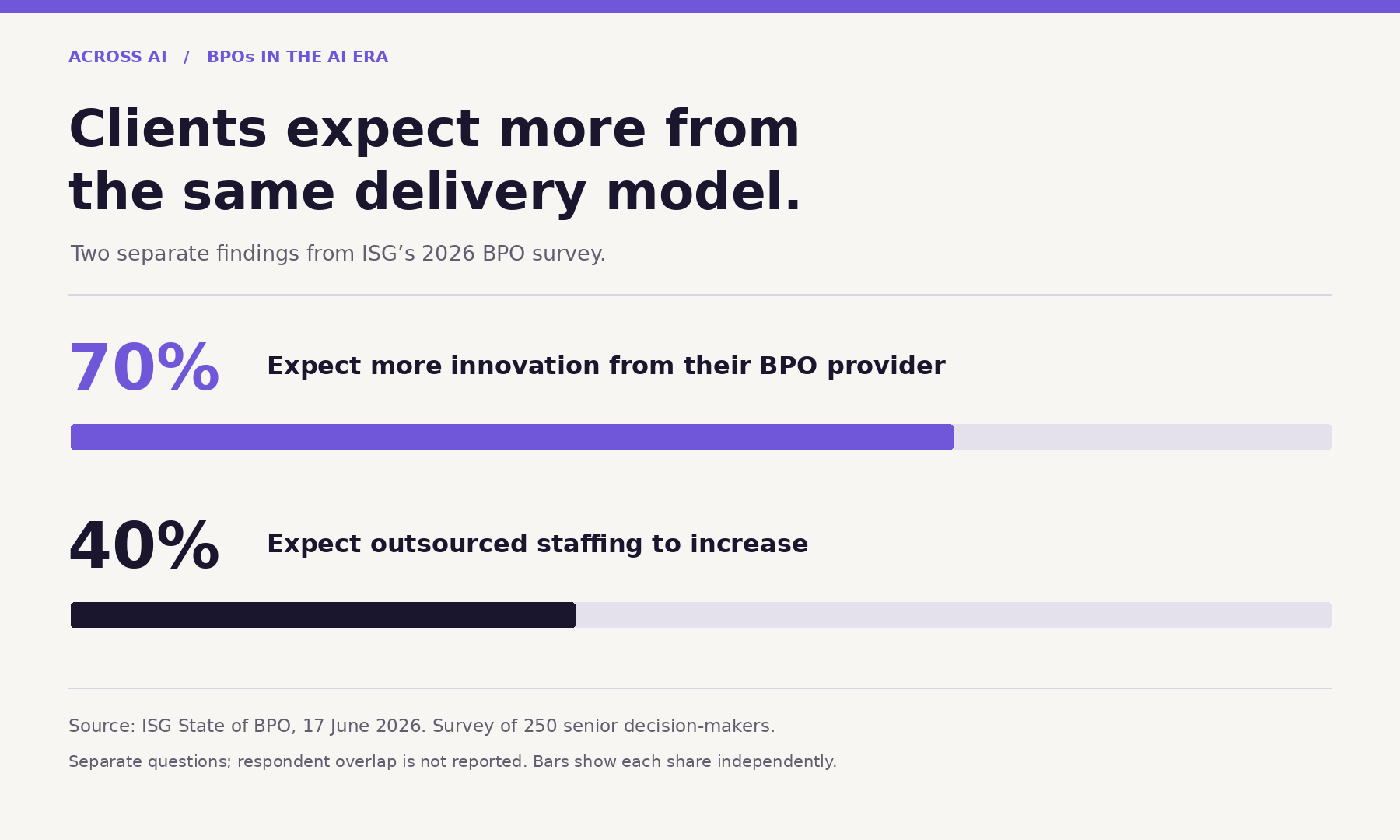
AI can reduce the manual effort in BPO delivery, but the bigger shift is commercial: clients are beginning to expect those efficiency gains to change what they pay for. New agentic tools and expanding in-house capability give them alternatives, putting pressure on providers to explain how productivity gains are shared and what additional outcomes they can deliver.
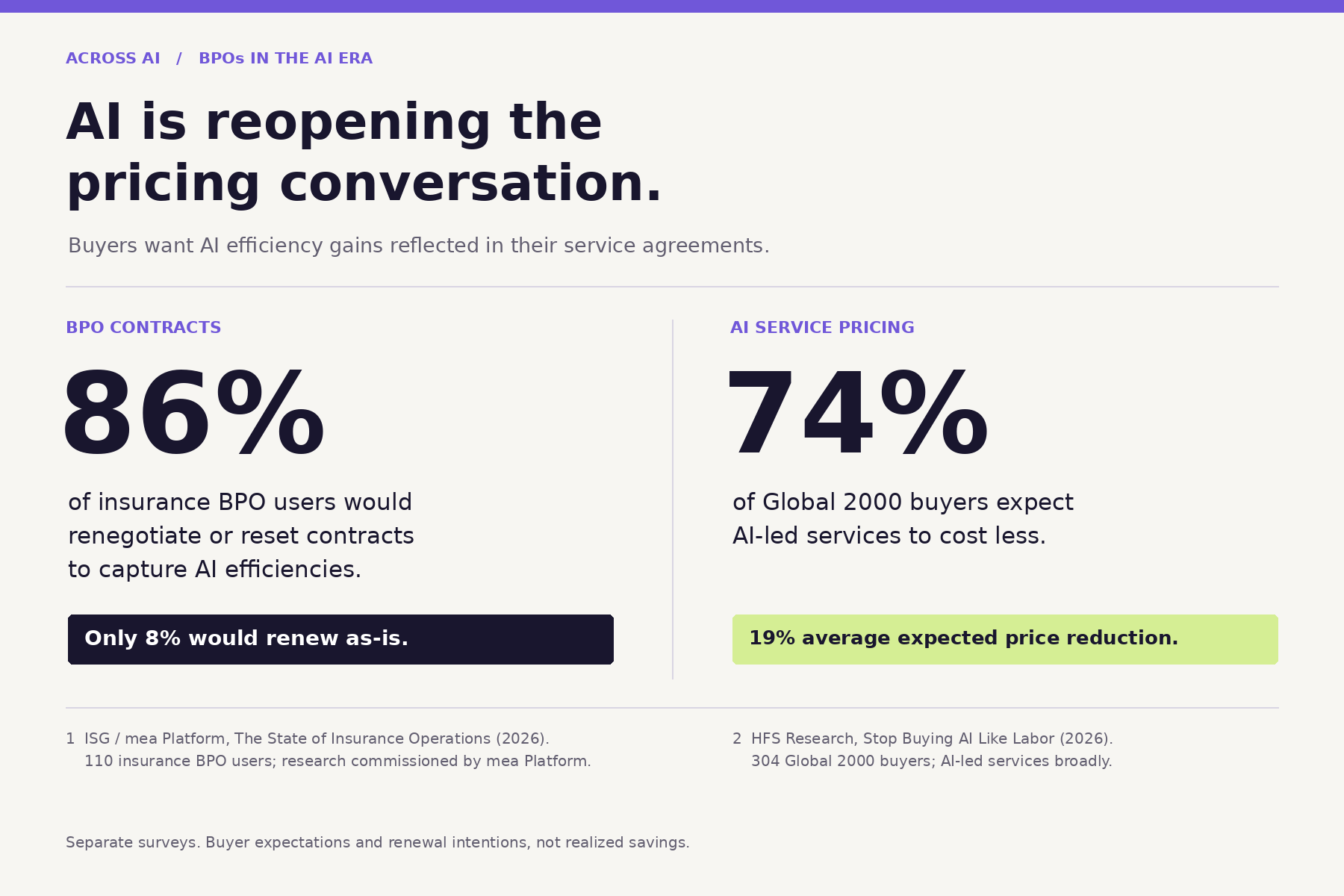
Figure 1. AI is reopening service pricing. Left: 86% of surveyed insurance BPO users would renegotiate or reset contracts to capture AI efficiencies; only 8% would renew as-is (n=110). Right: 74% of Global 2000 buyers expect AI-led services to cost less; average expected reduction: 19% (n=304). The second survey covers AI-led services broadly, not BPO alone. [9][10]
Taken together, these figures show why efficiency is now a commercial issue. When AI reduces the effort required to deliver a service, clients may expect some of that gain in price, while BPOs need to show how they can use released capacity to provide a broader or more dependable service. The opportunity is to negotiate around outcomes and scope, rather than assume a blanket discount.
The questions clients are asking
1. Who keeps the productivity gain?
Of course, under a fixed fee arrangement, reducing the effort needed to deliver the agreed service can improve a BPO’s margin, after technology, implementation and review costs. But clients know AI should make delivery more efficient, so it is reasonable for them to ask why they are not seeing part of that benefit. Under hourly billing, lower effort can affect revenue immediately. [5]
They also have more ways to get the work done. ISG points to in-house operations, global capability centers and software platforms as alternatives to traditional outsourcing. [2] As routine processing becomes easier to replicate, we think it will become harder to defend the same fee simply for doing the same work.
Deloitte’s 2025 Global Business Services Survey reflects those expectations: 66% of surveyed organizations planned to invest in GenAI over the next three years, with better productivity, less manual work and greater innovation among their leading expected benefits. [4]
In all likelihood, BPOs will have to give up some of the productivity gain through lower fees or more work within the same fee. How much they can keep will depend on what else the client gets from the relationship, and how easily that can be replaced. Which brings us to the second question.
2. Why should clients continue to use BPOs when the alternatives have gotten so much better?
Clients still need someone who understands how their processes work and takes responsibility for running them. Knowing a client’s contracts, systems, approval rules and recurring disputes, often built up over years, remains valuable when it leads to better decisions and less work for the client.
But we think generating the same revenue as AI reduces delivery effort will increasingly require BPOs to improve the quality of their offering and take on more of the process. That could mean moving upstream to prevent recurring problems, or downstream to investigate exceptions, coordinate decisions and see cases through to resolution. Where that work is already in scope, the opportunity is to do it more consistently and economically. Where the client still handles it, there may be an opportunity to extend the service.
Taking work off the client’s hands also means owning the difficult days. Someone needs to keep urgent work moving, find the cases affected when something goes wrong and explain what happens next. A client buying an AI tool still needs to arrange for that work to be done.
Better visibility is part of the offering too. ISG’s finance outsourcing research highlights working capital, dispute resolution and control over sensitive decisions. [3] Clients should be able to see which balances remain open, what is holding them up and who needs to act. Reporting how many invoices were processed only tells part of that story.
For a smaller provider, the challenge is finding the time and skills to build this broader service while keeping existing clients well served. Deloitte also highlights continuing demand for skilled talent in GBS. [4] A technology partner needs to fit the operation, including integration, review and ongoing support. The commercial opportunity is to take more operational work off the client’s hands, with better results and less need for the client to intervene.
Where exception resolution consumes effort
Finance BPOs already offer exception investigation and resolution. [6, 7] In the two illustrative cases below, the matching task is complete but an analyst still needs to establish the right resolution.
| Illustrative case | Task completed | Resolution work still required |
|---|---|---|
| AP: $10,500 invoice against a $10,000 PO | The $500 mismatch is detected. | Verify the claimed price change; obtain an authorized decision or a corrected invoice. |
| AR: $48,000 received against a $50,000 invoice | The receipt is applied; $2,000 remains. | Establish whether the deduction is valid; obtain approval or pursue the balance. |
Where resolution is in scope, the BPO already owns the investigation and follow-up, even if the case moves to another team within the provider. The client may retain approvals it has not delegated. Analyst time spent gathering evidence, reviewing the case and pursuing the next action contributes to delivery cost. [8]
The result needs an honest description. An approved credit, a corrected invoice and additional cash received have different effects, even when each closes a case.
The opportunity for a smaller specialist
For a firm whose current contract covers cash application but leaves deduction investigation with the client, taking on selected short payments would be an extension of scope. A firm already responsible for those cases would instead be improving the economics of its existing service. AI could make either proposition more economical to deliver, subject to quality and full delivery costs.
The first test is whether the provider can offer a better service after accounting for evidence access, integrations, review and support. Expertise provides a starting point; dependable delivery and a viable agreement make it a business.
Our view is that finance BPOs should start with the difficult cases they are already responsible for. Can those cases be resolved more consistently with less delivery effort? The next commercial question is how to use the capacity released, including whether the client values an additional service.
Discuss an AP or AR workflow with Across.
Sources
[1] ISG Americas Q3 2026 Index release
[2] ISG State of BPO study summary
[3] ISG Enterprises Pursue Resilient Financial Operating Models
[4] Deloitte unveils the 2025 Global Business Services Survey
[5] Genpact 2025 Form 10-K: pricing and productivity commitments
[6] Infosys BPM: Procure-to-Pay outsourcing services
[7] Wipro: Accounts Payable Team Lead responsibilities